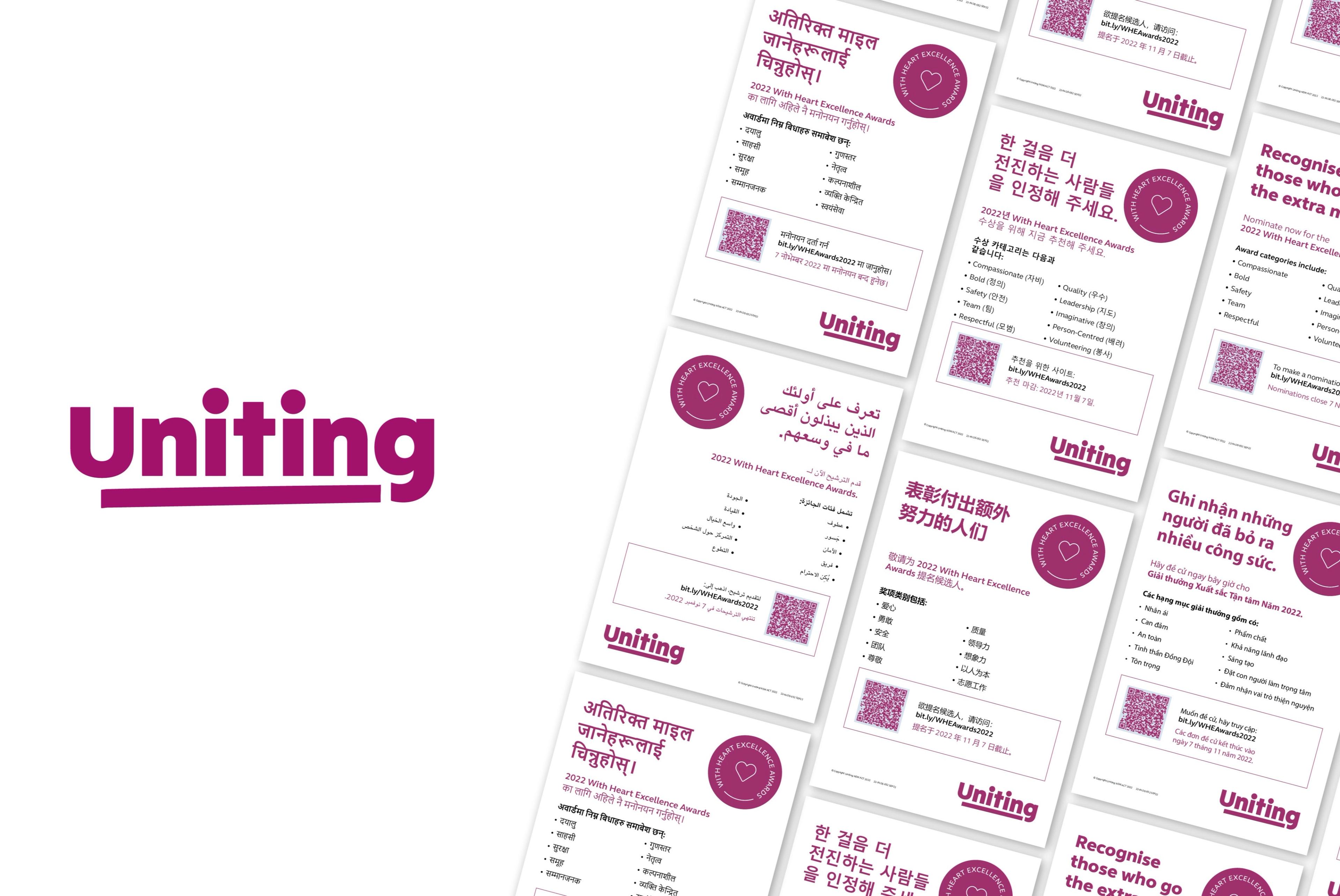
Translation for government departments, health services and enterprise teams, in 171 languages. Every translation is revised by a second linguist and delivered by a NAATI Endorsed, triple ISO certified provider.
NAATI Endorsed LSP950085 · ISO 17100 · 9001 · 27001
50+Government departments
171Languages
LSP950085NAATI Endorsed provider
Triple ISOISO 17100, 9001 and 27001
Trusted by government and enterprise
Federal and state departments, health services, community organisations and national brands send us the translations that have to be right.
Services Australia
Medicare
Centrelink
Department of Home Affairs
Queensland Health
Victoria Police
Translation people can act on
Every organisation that translates finds out eventually whether the translation worked. A community worker in Fairfield reads the brochure aloud and stops halfway through. A nurse watches a patient sign a consent form they clearly haven't read. A campaign goes out in eleven languages and nothing moves.
The file comes back, the script is right, the layout holds. Whether the meaning survived is a separate question, and it's the only one that counts.
We've been answering that question since 2011, across 171 languages and a vetted network of more than 10,000 translators. Sometimes it's an urgent consent form. Sometimes it's a decade-long program across 550 services. The standard doesn't move.
Birth and marriage certificates, academic transcripts, police checks and statutory declarations, stamped by a NAATI certified translator so Home Affairs, a court, a registry or a university accepts them.
Public information
Patient information, consent forms, discharge instructions, tenancy agreements, safety notices and entitlement letters. High stakes, and no tolerance for ambiguity.
Where word-for-word stops working and transcreation starts. Headlines, scripts and campaign assets rebuilt so the idea lands, not just the words.
Digital and technical
Websites, apps, e-learning, tender responses, policy and technical manuals, returned in the format you work in rather than as a file someone has to re-key.
Typesetting and print
Print-ready artwork in every script, including right-to-left and complex scripts, set to your brand guidelines and checked by a native reader.
You need certification for visa and citizenship applications, court and tribunal evidence, university admission, professional registration and most government submissions. You don't need it for a campaign, a newsletter, a website or a community fact sheet. Certification tells you who did the work. It doesn't tell you the copy lands.
How it works
Every project is scoped to its content, languages and deadline, and quoted as a fixed price before work starts.
01
Brief
Send the content, who it's for, the languages and the deadline. We come back with a plan, a team and a fixed price.
02
Translate and revise
A professional translator, NAATI certified where the work requires it, translates with your terminology. A second qualified linguist revises every translation before it leaves us.
03
Deliver and reuse
Delivered in the format you work in, ready to publish or print. Every approved segment is stored in your translation memory, so the next project costs less.
Every provider says their translation is accurate. These are the parts of ours a procurement panel can check.
Revised by a second linguist
ISO 17100 makes accuracy checkable: a second qualified linguist revises every translation, and the revision is documented. What the three certifications cover.
Your fifth translation matches your first
A translation memory stores every segment we translate for you, and a termbase locks the terms you can't afford to see drift. A new translator inherits every decision the last one made.
Cheaper as it grows
Repeated content is matched against your memory instead of retranslated, so a document set that's 40 per cent boilerplate is quoted as one.
Capacity on the day
In 2020 we mobilised more than 180 professionals for Home Affairs and delivered over 200 pieces across 63 languages. How that ran.
Secure by standard
Personal documents and sensitive government material are handled under ISO 27001 certified information security, inside ISO 9001 quality management.
171 languages, one network
More than 10,000 vetted translators, including the smaller community languages other providers decline. If a language isn't on our list, ask.
From our customers
In their words, as they gave them.
Quick turnaround, clear communication and super friendly team! I always choose LEXIGO for my translations for these exact reasons.
Tanja S.
I have contacted LEXIGO to get translations from many languages to English. We have been in communication for 3 years now and I have been more than happy with them since the first project. The quality of deliverables is excellent and their speed is really fast.
Yanni K.
I have used the translation services and have found their work to be very professional and accurate, the level of support is exceptional and the overall process a quick and easy one.
Billy L.
I highly recommend LEXIGO, apart from the great service, they also have very quick turnaround. Thank you so much for the priority service!
Michelle T.
Fantastic service! I have been using LEXIGO for a few years now on multiple jobs. Very professional and prompt service. Top notch, professional translation every time.
Daniel A.
Fast delivery and NAATI certified.
Assel O.
The languages Australians need most
Mandarin, Arabic, Vietnamese, Cantonese and Punjabi are the five languages most spoken at home after English, according to the ABS Census 2021. For Chinese the script decision comes before the translator does, and for Arabic the dialect does.
Translation is quoted per project, on word count, language, subject matter and deadline, because a 300-word consent form and a 300-word event flyer aren't the same job. Content matched against your translation memory is discounted, so an ongoing account costs less each year. Send the brief and you'll get a fixed price rather than a range. For a single certified document, see NAATI certified translation.
How long does translation take?
It depends on the volume, the languages and what the content has to do. Every project is scheduled against your deadline and includes the ISO 17100 revision step, which isn't a stage we skip to hit a date. For programs running across dozens of languages at once, we build the schedule backwards from your launch.
Which languages do you translate?
171, covering every language with a significant speaker base in Australia and many of the smaller community languages other providers decline. Vietnamese, Arabic, Mandarin, Cantonese, Punjabi, Greek, Italian, Hindi, Nepali, Assyrian Neo-Aramaic, Dari, Hazaragi, Khmer, Karen, Dinka, Nuer, Tigrinya and Rohingya are all routine work here. If a language isn't on the list, ask, because the list moves.
What's the difference between certified and standard translation?
A certified translation carries a NAATI certified translator's stamp and credential number, so an official body can verify who did the work. You need one for visas, courts, universities and most government submissions. Standard translation covers everything else, from websites to campaigns and fact sheets, and goes through the same ISO 17100 revision step without the stamp. See NAATI certified translation for document requirements.
What do you need from us to start?
The source file in an editable format if you have one, the target languages, the deadline and who the reader is. That last one changes the most: content for newly arrived refugees, for second-generation professionals and for elders who've been here forty years needs different registers even in the same language. If you have existing translations, send those too and we'll build a memory from them rather than starting from nothing.
Reading on translation
Guides from our team on certification, procurement and getting a translation right the first time.
Sometimes a translation fails because the English was never going to survive it. A call to action that quietly assumes a Medicare card, a myGov login and a printer. Translating harder won't fix that.